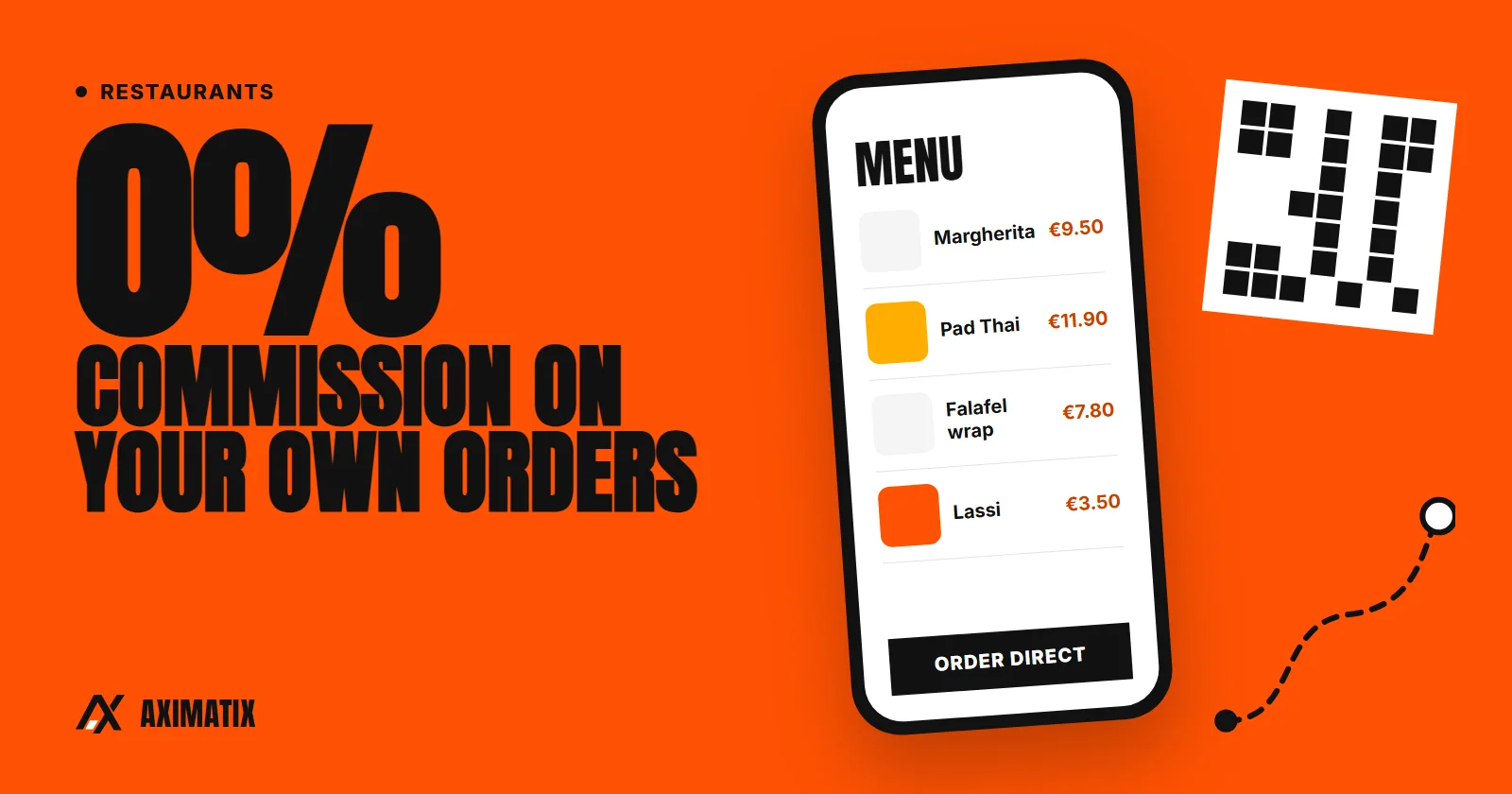
Delivery platforms bring restaurants new customers, but they take a share of every order, including orders from regulars who would have ordered from you anyway. For many independent restaurants that commission is the difference between a profitable month and a break-even one. This guide explains what commission really costs, the commission-free alternatives available today, and how to move your regular customers to ordering direct. It draws on what we have learned building and running Eatzino, our own zero-commission ordering platform for restaurants in Germany.
What commission really costs
Marketplace commission commonly ranges from around 15% to 30% of the order value, depending on the platform, the country and whether the platform also provides the delivery driver. On top of that come payment fees and sometimes charges for promotions or better placement.
Take an illustrative restaurant with 600 online orders a month at an average of ₹800 (or €25 in Germany):
| Illustrative example | Marketplace at 25% | Fixed-fee direct ordering |
|---|---|---|
| Monthly online sales | ₹4,80,000 | ₹4,80,000 |
| Commission | ₹1,20,000 | None |
| Fixed platform fee | None | A fixed monthly price |
| Payment processing (about 2%) | Often included in commission | ≈ ₹9,600 |
Restaurants typically run on thin margins, so a quarter of revenue going to a platform often takes most of the profit on that order. And because the platform owns the customer relationship, you usually cannot contact those customers directly to bring them back.
The commission-free alternatives
1. Your own online ordering website
A branded ordering page where customers choose dishes, pay online and pick delivery or collection. It can be linked from your Google Business Profile, Instagram and website. You pay a fixed fee or a one-off build cost instead of a percentage. This is the single most effective step for most restaurants.
2. QR code ordering at the table
Guests scan a code on the table, browse the menu on their phone and order and pay without waiting for staff. It speeds up service at peak times, makes a second round of drinks effortless and frees staff to look after guests rather than take orders.
3. Your own mobile app
An app makes sense once you have a loyal base of regulars or several locations: reordering favourites, loyalty rewards and push notifications all become possible. For a single small restaurant, a fast mobile website usually achieves most of the benefit at lower cost.
4. A till that ties it together
The real gains come when online, QR and counter orders all arrive in one point-of-sale system and go straight to the kitchen. Juggling three tablets from three services is how orders get missed.
What a complete setup includes
- A menu that is easy to update, with photos, options, allergens and opening hours in one place.
- Online payment, plus cash or card on collection if you want it.
- Delivery zones and fees, or collection only.
- Orders flowing into your till and kitchen without re-typing.
- A way for your own drivers to receive and complete deliveries, if you deliver.
- Your own customer list, so you can invite people back.
- Reports on what sells, when and through which channel.
How to move regulars to direct ordering
- Put a card in every bag. Platform orders still reach your kitchen. A card with a QR code to your own ordering page reaches your best customers at the right moment.
- Update your Google Business Profile with a direct order link, so people searching for you find your page first.
- Reward ordering direct, for example a small discount on collection or a free side on the first direct order. You can afford it because you are not paying commission.
- Use your own channels: Instagram, WhatsApp updates and your website should all point to direct ordering.
- Make it as easy as the app they already use. If your page is slow or confusing, customers go back to the marketplace.
Many restaurants keep a presence on the big platforms to be found by new customers, and treat direct ordering as the home for everyone who comes back. That balance keeps discovery while cutting commission on repeat business.
What we learned building Eatzino
Eatzino is a brand of Aximatix Private Limited, launched in Chemnitz, Germany, in English and German. Restaurants pay a fixed monthly price instead of a cut of every order, so 100% of the menu price stays with them. The platform includes five parts: a customer website and app, a restaurant till for Windows and Android, table QR menus, a partner app for owners to manage menus and orders, and a driver app for deliveries.
Building and running it ourselves taught us a few things that apply to any restaurant project:
- One system beats several. Owners want every order, from any channel, in one place.
- Menu updates must be quick. If changing a price or marking a dish sold out takes more than a minute, it doesn’t get done.
- Reliability matters more than features. A missed order on a Friday night costs more goodwill than any feature earns.
- Language and local habits matter. Payment methods, delivery expectations and even menu layout differ by market.
Getting started
If you run a restaurant, start with an honest look at your numbers: how many orders arrive through platforms, what you pay in total, and how many of those customers are regulars. If you want a platform like this for your own market or brand, we can help you decide whether to build one, adapt an existing platform, or combine the two. See our work for food and hospitality, read about Eatzino, or book a free consultation.
Frequently asked questions
What is commission-free online ordering?
It is an ordering system, usually your own website or app, where you pay a fixed fee or a one-off cost instead of a percentage of every order. You keep the full menu price, minus payment processing.
Should I leave delivery platforms completely?
Not necessarily. Many restaurants keep platforms for discovery by new customers, and move their regulars to direct ordering, where each order costs far less.
Do QR code menus actually increase orders?
They make ordering faster at busy times and let guests order a second round without waiting for staff. Whether they suit you depends on your service style and your guests.