“How much will it cost?” is the first question almost every client asks us, and the honest answer is “it depends”. That answer is only useful if you know what it depends on. This guide gives you typical price ranges for software built in India in 2026, explains what pushes a project up or down those ranges, and shows you how to compare quotes so you are not comparing a bicycle with a car.
Typical cost ranges in 2026
The figures below are rough market ranges for work done by an established Indian development company, not freelancers and not large consultancies. They assume a professional process: design, development, testing, deployment and a short warranty period. Treat them as a starting point for a budget conversation, not a quote.
| Project type | Typical range (INR) | Typical timeline |
|---|---|---|
| Company website (custom design, CMS) | ₹50,000 – ₹3 lakh | 3–8 weeks |
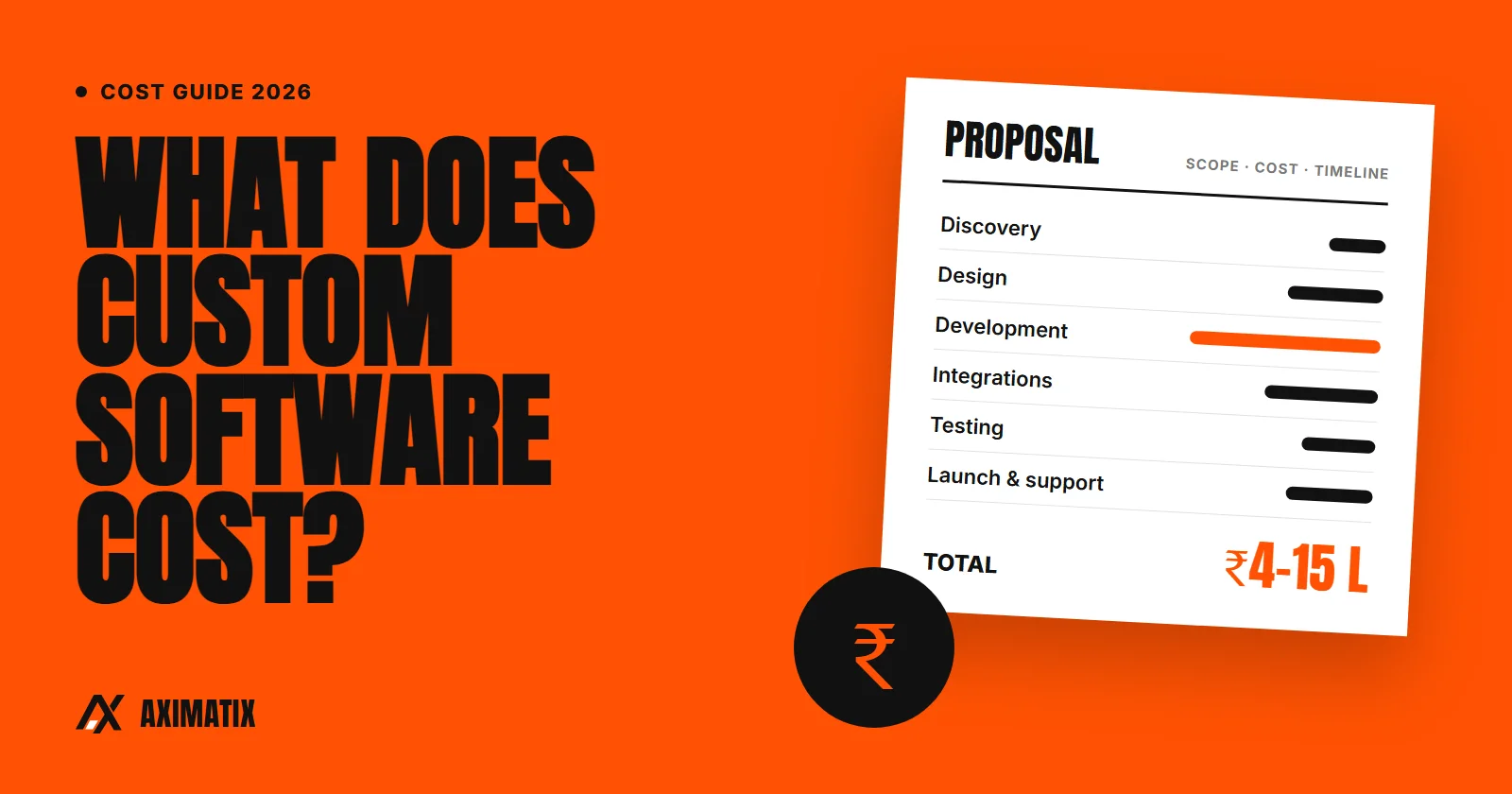
| First version of a web app or SaaS (MVP) | ₹4 – 15 lakh | 2–4 months |
| Cross-platform mobile app (iOS and Android) | ₹6 – 25 lakh | 3–6 months |
| Custom business software (portals, operations, ERP-style) | ₹15 – 60 lakh+ | 4–12 months |
| AI agent or automation pilot on one workflow | ₹3 – 12 lakh | 3–8 weeks |
| Cloud migration of an existing application | ₹2 – 20 lakh | 3–12 weeks |
Most Indian development companies charge somewhere between $20 and $50 an hour (roughly ₹1,700–₹4,200) for experienced developers, designers and testers. Rates outside that band usually signal either a very junior team or a specialist one.
What actually drives the cost
Two projects that sound identical in a single sentence (“an app for our customers to book appointments”) can differ in cost by a factor of five. These are the factors that make the difference.
1. Scope: the number and depth of features
Every screen, role and rule adds work. A booking app with one type of user and a calendar is a small project. Add staff rotas, deposits, cancellations with refund rules, reminders by SMS and WhatsApp, and a reporting dashboard, and it becomes a large one. The single most effective way to control cost is to decide which features the first version genuinely needs.
2. Platforms
A web app, an iOS app and an Android app are three surfaces to design, build and test. A shared codebase for iOS and Android (for example with Flutter or React Native) usually costs far less than two separate native apps, and suits most business products. Separate native apps are worth it only when the product needs deep device features or exceptional performance.
3. Integrations
Connecting to your CRM, accounting software, ERP, payment gateway or a government API is often where hidden effort lives. A well-documented modern API might take a few days; an older system with no API can take weeks. Ask your developer to list every integration and estimate each one separately.
4. Design
Using a proven component library with your brand colours costs a fraction of a fully bespoke interface with custom illustrations and motion. Both are valid choices: public-facing products often justify more design investment than internal tools.
5. Data, AI and reporting
Dashboards, exports and audit trails take time. AI features add work for testing on real examples, measuring accuracy and building review steps where a person checks the result. They also add running costs for model usage, which should be estimated before you commit.
6. Security and compliance
Software that handles health records, payments or personal data needs stricter access control, logging, encryption and testing. This is not optional, and a quote that does not mention it is incomplete.
7. Timeline
Compressing a six-month project into three months means a larger team working in parallel, which increases coordination cost. If your deadline is fixed, reduce scope before you add people.
Pricing models: fixed price, time and materials, or a dedicated team
| Model | How it works | Best for |
|---|---|---|
| Fixed price | An agreed price for an agreed scope. Changes go through a change request. | Clear, stable requirements; websites; well-defined first versions. |
| Time and materials | You pay for the hours worked, usually reviewed every week or two. | Products where you expect to learn from users and change priorities. |
| Dedicated team | A team works on your product full time for a monthly fee. | Long-running products with a continuous roadmap. |
A common and sensible pattern is a short, fixed-price discovery phase (requirements, user flows, technical plan and a firm estimate), followed by the build on whichever model suits the project.
The costs people forget
- Maintenance: security updates, bug fixes, operating-system and browser changes, small improvements. Plan for 15–20% of the build cost per year.
- Hosting and cloud: from a few thousand rupees a month for a small app to much more for high-traffic systems. A good setup lets you see exactly what you are paying for.
- Third-party services: SMS and WhatsApp messages, email delivery, maps, payment processing fees, AI model usage.
- App store accounts: Apple charges an annual developer fee; Google charges a one-off registration fee.
- Your own team’s time: someone on your side needs to answer questions, review work and test. Budget for it.
How to reduce the cost without cutting corners
- Start with the smallest version worth launching. Launch the core workflow, learn from real users, then add features in order of value.
- Use off-the-shelf tools where they fit. Authentication, payments, email and analytics rarely need to be built from scratch. Read our guide to custom software versus off-the-shelf.
- Choose a shared codebase for mobile unless you have a specific reason not to.
- Write down your requirements. Even a one-page list of users, tasks and must-have rules makes estimates more accurate and reduces expensive surprises.
- Modernise in stages. Replacing an old system piece by piece keeps the business running and spreads the cost.
How to compare quotes
When two quotes differ wildly, it is usually because they describe different projects. Before comparing totals, check that each quote answers these questions:
- Which features, screens and user roles are included, and which are explicitly excluded?
- Is design included, and how many rounds of revisions?
- Which integrations are included, and has each one been estimated?
- How is testing done, and on which devices and browsers?
- Who sets up hosting, deployment and monitoring?
- What happens after launch: is there a warranty period, and what does support cost?
- Who owns the code, and will you receive the source and documentation?
- How often will you see working software, and how are changes handled?
How we price projects at Aximatix
We price every project individually, because no two businesses need exactly the same thing. It starts with a free consultation where you tell us what you are trying to achieve. We follow with a discovery meeting to go through your requirements, current systems and constraints. You then receive a written proposal with the recommended approach, the scope, the cost and the timeline. If a simpler or cheaper tool would do the job, we will tell you.
See what we build in custom software, web and mobile apps and AI and automation, or book a free consultation to get a figure for your project.
Frequently asked questions
How much does a basic business web app cost in India?
A focused first version of a business web app, with login, a few core screens and an admin panel, commonly falls between ₹4 lakh and ₹15 lakh. The final figure depends on the number of features, integrations and the level of design.
Is fixed price or time and materials better?
Fixed price suits work with a clear, stable scope. Time and materials suits products where you expect to learn and change direction. Many projects use a fixed-price discovery phase followed by either model.
How much should I budget for maintenance each year?
A common rule of thumb is 15–20% of the original build cost per year, covering security updates, bug fixes, monitoring and small improvements. Hosting and third-party services are on top of that.
Why are Indian development rates lower than in the US or Europe?
Mainly because salaries and operating costs are lower. Quality depends on the team, not the country, so judge a company by its work, its process and how clearly it explains your options.