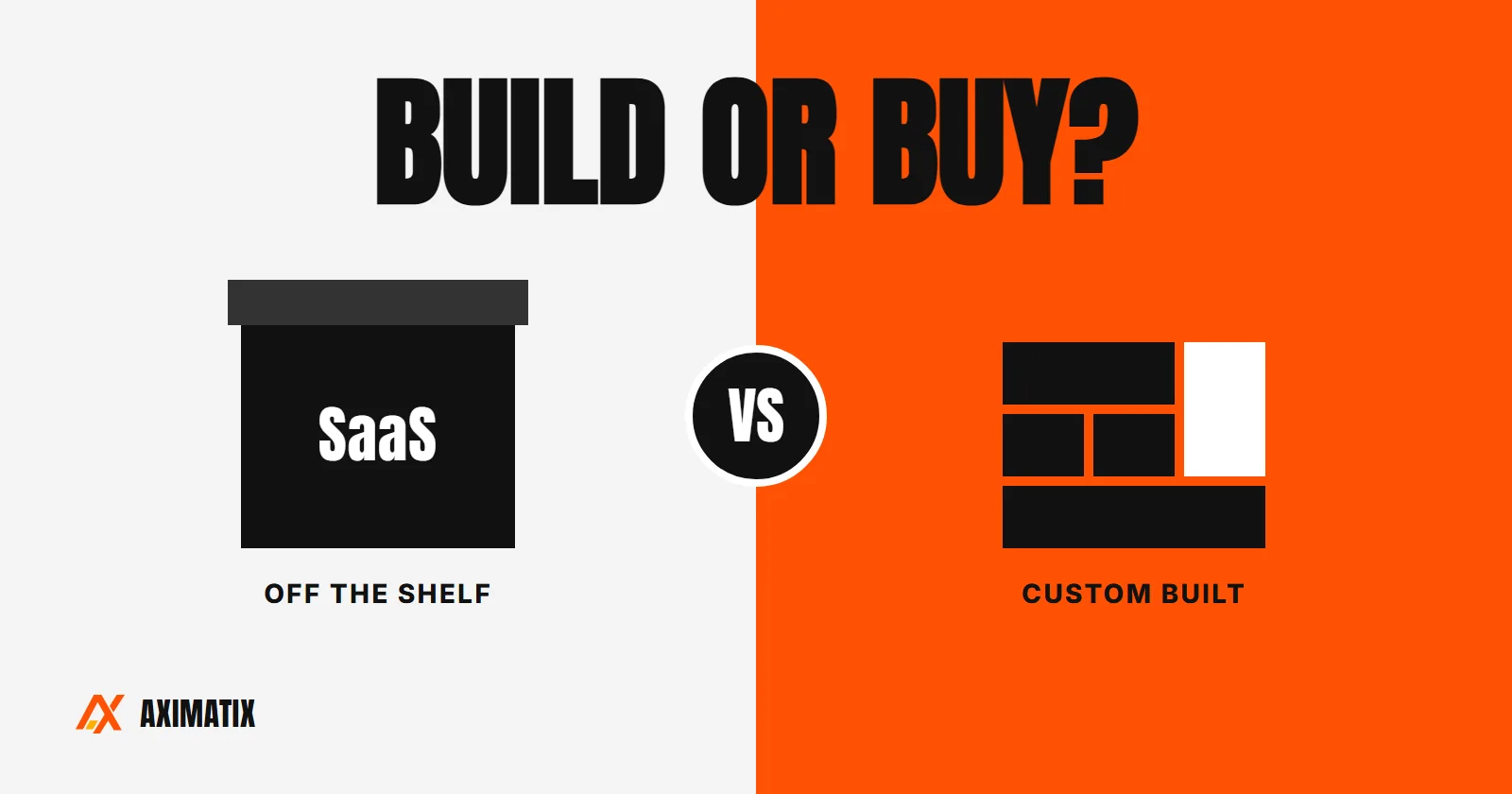
Every growing business eventually hits the same question: keep paying for a ready-made tool and working around its limits, or build something that fits? Both answers can be right. The mistake is choosing on gut feel, or on the up-front price alone. This guide sets out when each option wins, the hybrid route that often beats both, and a checklist you can use in your next planning meeting.
What we mean by each
Off-the-shelf software (also called packaged software or SaaS) is built once for many customers: think accounting packages, CRMs, project-management tools and e-commerce platforms. You subscribe, configure it, and adapt your process to it.
Custom software is built for one organisation around the way it works: a customer portal, an operations system, a pricing engine, an internal tool. You own it and decide how it changes.
Side-by-side comparison
| Off-the-shelf | Custom | |
|---|---|---|
| Up-front cost | Low | Higher |
| Ongoing cost | Subscription, often per user, rising with headcount | Hosting and maintenance, largely independent of users |
| Time to start | Days | Weeks to months |
| Fit to your process | You adapt to the tool | The tool adapts to you |
| Integrations | Whatever the vendor supports | Whatever you need |
| Control of the roadmap | The vendor’s | Yours |
| Competitive advantage | None: competitors can buy the same tool | Possible, if the process is what sets you apart |
| Risk | Price rises, discontinued features, vendor lock-in | Delivery risk, dependence on a good development partner |
When off-the-shelf is the right answer
- The process is the same in most businesses: payroll, accounting, email, basic HR, generic project tracking.
- A well-known tool covers most of what you need without workarounds.
- You need something working this month and can revisit later.
- You have a small number of users, so per-user pricing stays affordable.
Choosing a ready-made tool for these jobs is not settling. It frees your budget for the work that actually differentiates you.
When custom software pays for itself
- Your process is your advantage. If the way you quote, schedule, price or serve customers is why they choose you, forcing it into a generic tool erodes that advantage.
- Workarounds have become a job. Spreadsheets bridging two systems, data typed in twice, reports assembled by hand every Monday.
- Per-user fees are outgrowing you. Fees that seemed small for ten people look different for a hundred.
- You need an integration that doesn’t exist, such as a link to an industry system, a government portal or an older in-house tool.
- You are building a product to sell. If software is the product, you need to own it.
The hybrid option most businesses overlook
The choice is rarely all or nothing. Some of the best-value projects we see keep the tools a business already relies on and build custom pieces around them:
- An integration that moves orders from the e-commerce platform into the accounting system automatically.
- A customer portal on top of the existing CRM, so customers can see their own orders and documents.
- An internal dashboard that pulls figures from four tools into one current view.
- An AI step that reads incoming documents and fills in the fields your existing system needs. See our guide to AI agents for business.
You keep the reliability of proven tools and remove the manual work between them, at a fraction of the cost of replacing everything.
Comparing the cost over three years
Here is an illustrative way to compare the options. The numbers are examples to show the method; use your own quotes and headcount.
| Illustrative example: 40 users | Off-the-shelf | Custom |
|---|---|---|
| Set-up or build | ₹1 lakh (configuration) | ₹15 lakh |
| Subscription (₹1,500 per user per month) | ₹7.2 lakh a year | None |
| Hosting and maintenance (about 18% of build) | Included | ₹2.7 lakh a year |
| Staff time lost to workarounds (2 hours per user per month at ₹400/hour) | ₹3.8 lakh a year | Minimal |
| Total over 3 years | ≈ ₹34 lakh | ≈ ₹23 lakh |
Change the inputs and the answer changes: with 8 users and no workarounds, the subscription wins easily. That is the point. Run the numbers for your situation before deciding. Our custom software cost guide helps with the build side.
A 10-question checklist
Answer these with your team. The more “yes” answers in the second half, the stronger the case for custom or hybrid.
- Is there a well-known tool that does at least most of what we need today?
- Can we export all our data from it, and does it offer an API?
- Will its per-user price still be acceptable at twice our current headcount?
- Does the process we want to support make us different from competitors?
- Are people re-typing the same data into more than one system?
- Are spreadsheets holding together a process that matters to customers?
- Do we need an integration the vendor doesn’t offer?
- Have we been waiting on a vendor feature request for more than a year?
- Would owning the code reduce a real business risk?
- Will we keep improving this system for years, rather than set it up once?
Signs you have outgrown your current tools
- New staff take weeks to learn the workarounds.
- Reports are assembled by hand and nobody fully trusts the numbers.
- Customers ask for things your system makes impossible, such as self-service or live status.
- You pay for three tools that each do part of the job.
How we help you decide
We are a software company, but we will tell you honestly when you don’t need custom software. In a free consultation we look at your process and current tools, and recommend the simplest option that works: a ready-made tool, an integration, a custom system, or a combination. If custom makes sense, you get a written proposal with the scope, cost and timeline. Explore our custom software development service or book a free consultation.
Frequently asked questions
Is custom software more expensive than off-the-shelf?
Up front, almost always. Over several years it can cost less if you are paying per-user fees for many people, paying for workarounds, or losing time to manual steps the tool can’t handle. Compare the total cost over three to five years.
Can we start with off-the-shelf and move to custom later?
Yes, and it is often the sensible route. Choose tools that let you export your data and offer an API, so you can integrate with them or move away later without starting from nothing.
Who owns custom software?
Ownership of the code is set out in your agreement with the developer. Make sure it is written down before work begins.